Decentralized Power and Village Electrification
One of the most valuable roles for biomass gasification is bringing electricity to places the grid struggles to reach. Because a gasifier runs on locally gathered fuel and can be sited almost anywhere, it is a natural fit for decentralized, community-scale power.
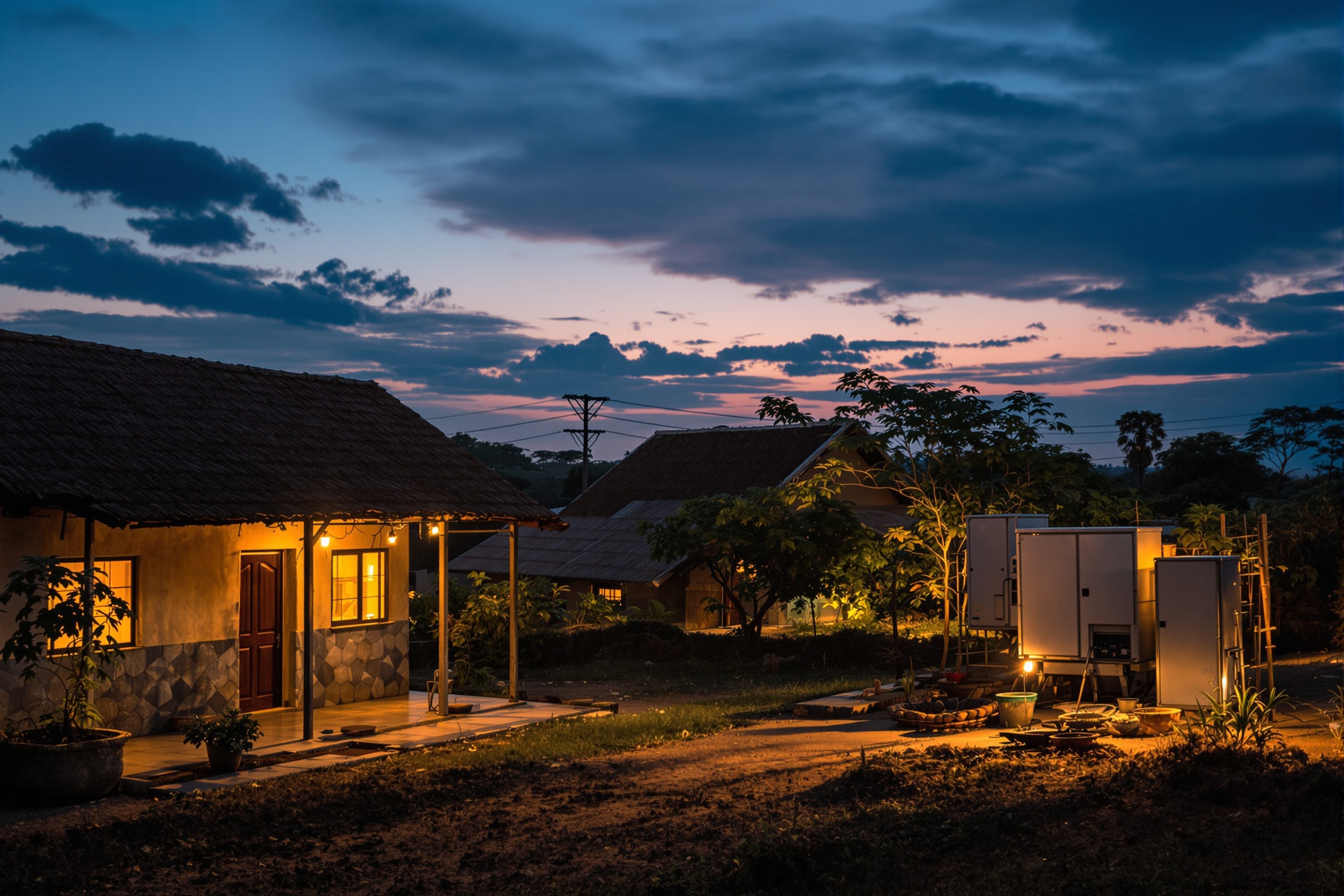
The energy-access challenge
Hundreds of millions of people still live with unreliable power or none at all, most of them in rural areas far from transmission networks. Extending the central grid to scattered, low-demand villages is often slow and costly. International Renewable Energy Agency (IRENA) and the International Energy Agency both identify decentralized renewable generation as a key route to closing the energy-access gap.
The UN's 2025 Goal 7 report puts global electricity access at 92% in 2023, up from 84% in 2010. Some 666.4 million people remained without electricity, 18.8 million fewer than in 2022; 45 countries achieved universal access between 2010 and 2023. Yet 84% of those without electricity lived in rural communities. Sub-Saharan Africa accounted for 85% of the global deficit, with its unconnected population barely changing from 566 million to 565 million. Current trends point to 645 million people still without power in 2030. Cooking fuel is a parallel access gap: the discussion of gasifier cookstoves and clean cooking explains why household heat also belongs in energy-access planning.
Why gasification suits rural settings
Biomass gasifiers have several features that make them well matched to village power:
- Local fuel — woody biomass and crop residues are frequently available in exactly the rural places that lack power.
- Multi-locational capability — a unit can be installed wherever feedstock and demand coincide, without geographic constraints on wind or water.
- Dispatchable output — unlike solar or wind alone, a gasifier can supply power on demand, including after dark when villages need it most.
- Local livelihoods — collecting, drying and preparing fuel creates rural employment and keeps energy spending in the community.
Mini-grids and captive supply
At the community scale, a gasifier power unit can anchor a mini-grid serving homes, a school, a health centre, irrigation pumps and small enterprises. The same technology provides captive power to rural industry — agro-processing, cold storage and workshops — that would otherwise depend on expensive diesel. The practical routes to that electricity are described on the power generation page.
Beyond electricity
The value of village power reaches well past the light bulb. Reliable electricity extends study hours for children, allows health centres to refrigerate vaccines and run equipment, powers pumps for drinking water and irrigation, and lets people charge phones and tools without long journeys. Each of these unlocks time, income or wellbeing that the community previously went without. When a biomass mini-grid also creates local jobs in fuel collection and plant operation, the benefits compound: the same installation that keeps the lights on becomes a small hub of rural economic activity, which in turn strengthens the demand that keeps the plant running.
Making it sustainable
Village schemes succeed or fail on fuel logistics and maintenance. A dependable, sustainably sourced feedstock supply, trained local operators, and a plan for the gas-cleaning residues are all essential. Done well, decentralized biomass power delivers not just electricity but local economic value and lower emissions than the diesel it replaces — part of the broader environmental case for bioenergy.
Ownership and productive use
The technology is only half of a successful village scheme; the other half is how it is owned and used. Community cooperatives, private mini-grid operators and energy-service companies have all run gasifier plants, each model striking its own balance between local control and technical capacity. What most distinguishes thriving schemes is productive use: when power feeds irrigation pumps, agro-processing, workshops and cold storage rather than only household lighting, it generates the income that keeps the plant financially viable. Pairing electricity supply with these local livelihoods turns a power project into an engine of rural development. Reliable fuel logistics, transparent tariffs, and ready access to spare parts and trained technicians round out the conditions under which decentralized biomass power endures rather than stalling after its first serious breakdown.
A complement to other renewables
Decentralized biomass rarely stands alone. In many rural systems it works alongside solar and storage, providing firm, after-dark and seasonal power that intermittent sources cannot. Seen this way, gasification is one dependable building block in a diversified local energy system — a theme explored in our renewable comparison.