Power Generation from Biomass Gasification
Cleaned producer gas can drive an engine to generate electricity, giving communities and industries a renewable, dispatchable power source built on local fuel. There are two well-established routes, and the right one depends on the existing equipment and the appetite to eliminate fossil fuel entirely.
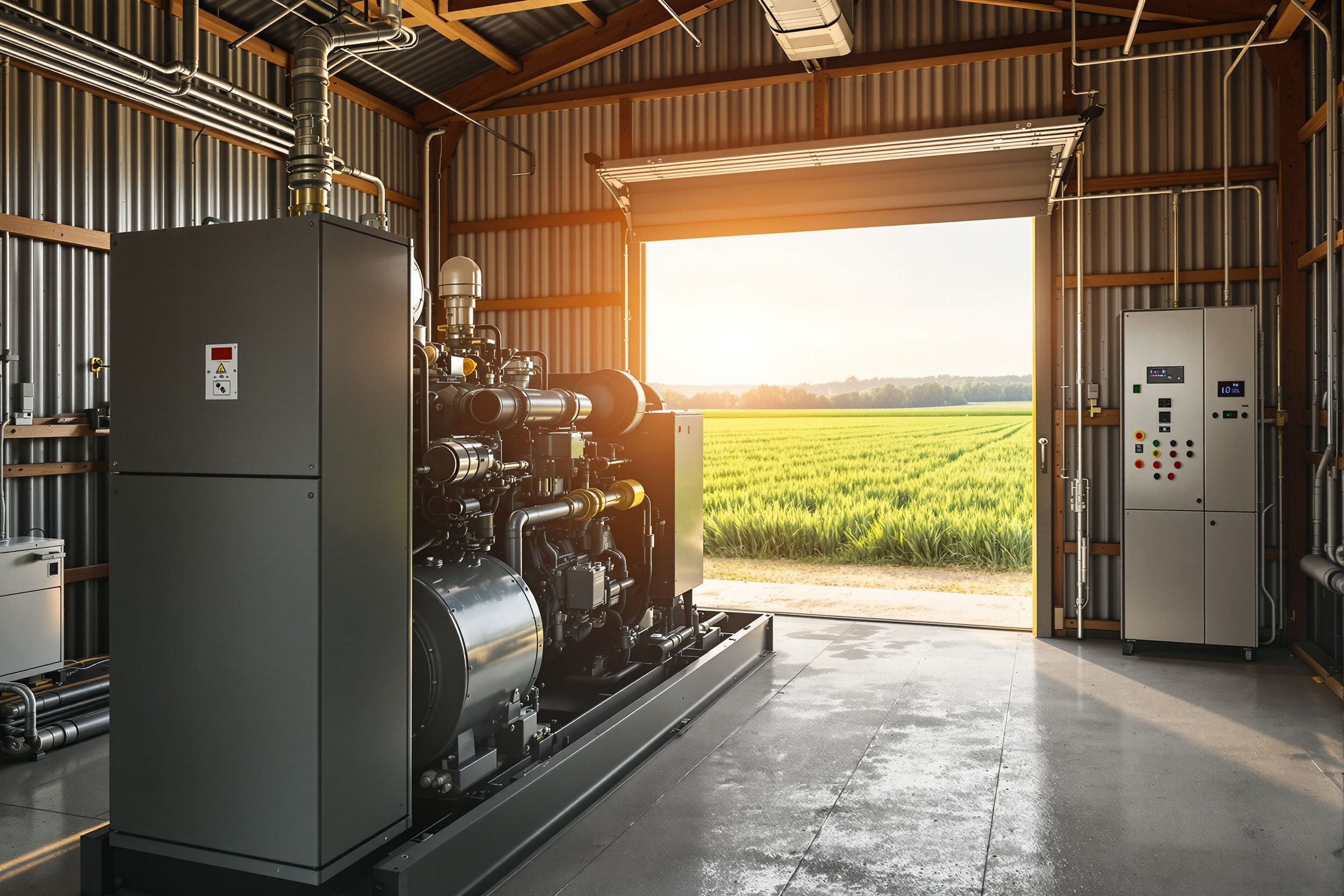
Dual-fuel mode
The simplest upgrade path is dual-fuel operation. Here a gasifier is retrofitted to an existing diesel or furnace-oil generator, and producer gas displaces most — but not all — of the liquid fuel. In a typical installation the gasifier replaces about 75–80% of the diesel, with a small pilot quantity of liquid fuel retained for ignition. As a guide, each unit of electricity then needs roughly 0.90 kg of biomass plus about 80 ml of fossil fuel. Dual-fuel is popular because it reuses existing gensets and is forgiving of variable gas quality.
100% gas engines
To eliminate fossil fuel altogether, a spark-ignited gas engine can run entirely on producer gas. This route removes the liquid-fuel bill completely; as a broad figure, each unit of electricity requires around 1.2 kg of biomass. Dedicated gas engines extract more renewable value but demand consistently clean, well-conditioned gas and careful engine management, so gas quality — and therefore reactor choice and gas cleaning — becomes critical.
Engine considerations
Because producer gas has a lower energy density than diesel or natural gas, engines running on it are typically derated — they deliver less peak power than on their design fuel. Consistent gas composition, thorough tar and dust removal, and good air-gas mixing all matter for reliable, long-lived operation. These are solved engineering problems, but they reward attention to the whole gas train, not just the engine.
Connecting to the load
How the generator connects to its load shapes the whole installation. In island mode, a gasifier set supplies a standalone load or mini-grid on its own, so its governor and voltage control must hold frequency and voltage steady as demand swings. In grid-tied operation, the set is synchronized to the utility grid and must match its frequency and phase precisely, with protection that disconnects safely during a grid fault. Power quality — stable voltage and frequency, clean waveform — matters in both cases, because sensitive equipment downstream depends on it. These are routine electrical-engineering tasks, but they must be designed in from the start rather than bolted on later.
Scales and configurations
Gasifier power systems span a wide range of sizes and roles:
- Captive generation, commonly from about 10 kW up to around 2 MW, powering a factory, estate or institution
- Village and mini-grid systems supplying decentralized communities — see village electrification
- Grid-linked plants exporting renewable power from biomass residues
Operation and maintenance
A gasifier power plant is a fuel-processing operation as much as a generator, and it rewards disciplined operation. Routine tasks include managing the fuel store, clearing ash and char, servicing the gas-cleaning train, and handling the tar-laden condensate the cleaning process produces. Engines running on producer gas need attention to filtration and periodic inspection, since poor gas quality shows up quickly as fouling. None of this is exotic, but it does mean that trained operators and a steady maintenance routine are essential to achieving the high plant load factor on which the economics depend. Increasingly, hybrid configurations — pairing a gasifier with solar panels and battery storage — are used to match output closely to demand while keeping fuel use efficient and the engine running in its sweet spot.
The economic case
Where biomass residues are cheap and grid power is expensive or unreliable, the delivered cost of gasifier electricity can undercut prevailing tariffs. National programmes such as India's Ministry of New and Renewable Energy and agencies like International Renewable Energy Agency (IRENA) have long supported biomass power as part of a diversified renewable mix, particularly for industry and rural areas.