Thermal Applications: Heat from Biomass Gas
The most direct way to use producer gas is as a fuel for heat. Across many industries, clean-burning biomass gas can be substituted for oil, diesel or gas in equipment that needs a controllable flame — often by retrofitting hardware that already exists.
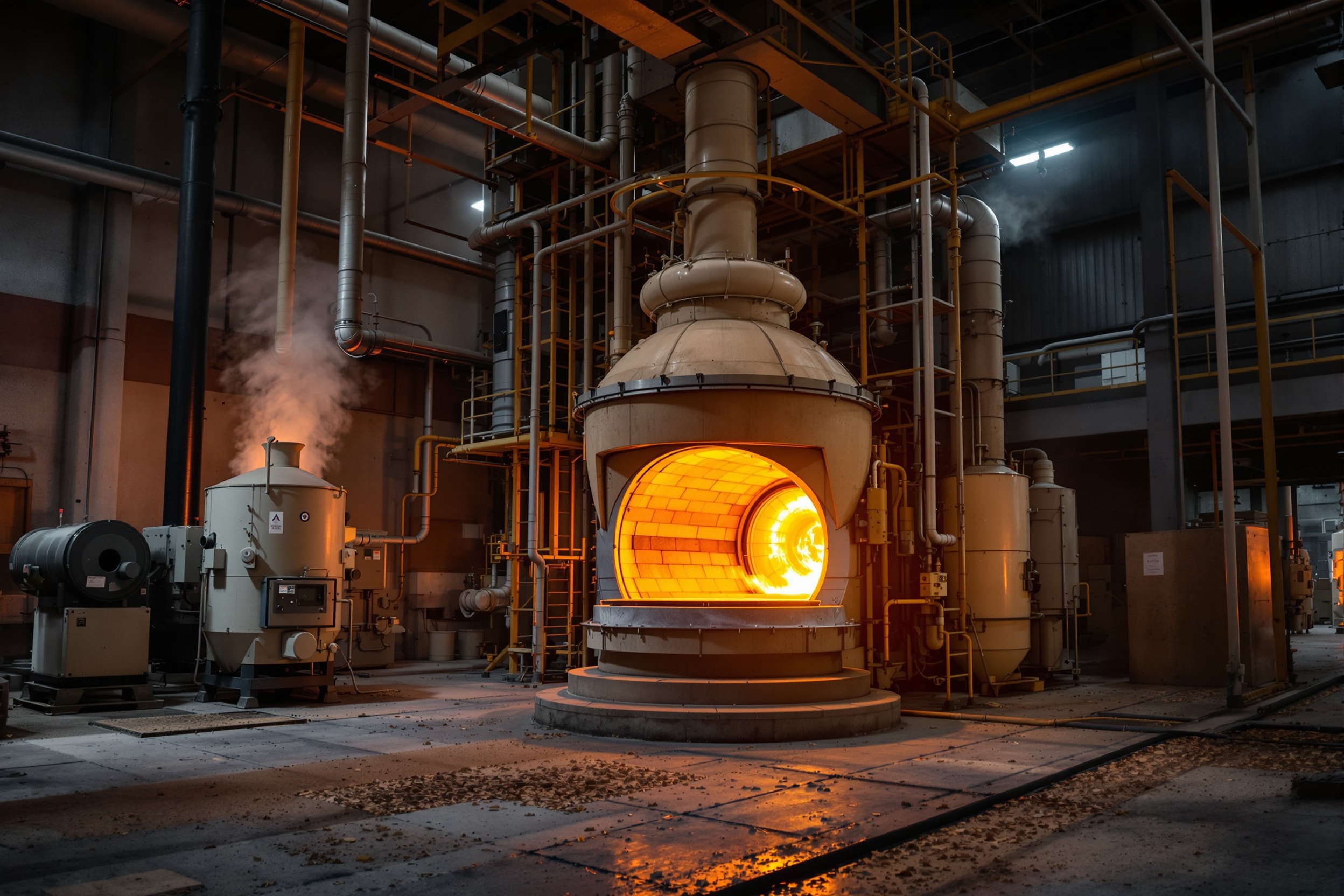
Where the heat goes
Producer gas can fire a wide range of industrial thermal equipment, including:
- Furnaces for melting, forging and heat treatment
- Kilns for ceramics, tiles, lime and refractory products
- Hot-air dryers for food, spices, tea, timber and agricultural produce
- Boilers raising steam for process heat
- Thermic fluid heaters that circulate hot oil for indirect process heating
In many of these, a gasifier can be retrofitted to existing fossil-fired equipment, so a plant keeps its process hardware and simply changes its fuel source.
The efficiency case
The economics are compelling where residues are cheap. As a broad guide, about 3.5 kg of biomass replaces roughly 1 litre of fossil fuel oil. Each kilogram of biomass releases on the order of 2–2.5 cubic metres of producer gas carrying around 1,100–1,200 kcal per cubic metre of thermal energy. With good burner design and proper premixing of air and gas, flame temperatures of up to about 1,200 °C are achievable — more than enough for most industrial heating duties.
Controlling the flame
Because the fuel arrives as a gas rather than a solid, heat can be modulated precisely, distributed to multiple burners, and delivered with a clean flame. That controllability is a genuine process advantage over burning solid biomass directly, and it is why gasification suits processes that need consistent, adjustable heat.
Combined heat and power
Where a site needs electricity as well as heat, combined heat and power (CHP) makes the most of every kilogram of fuel. In a CHP arrangement the cleaned gas runs an engine to generate power, and the heat that engine would otherwise waste — from its jacket cooling and hot exhaust — is recovered for process drying, hot water or space heating. Capturing both streams can lift the overall useful-energy efficiency of the system well above what either heat or power alone achieves. CHP is especially attractive for operations such as food processing that have a continuous, year-round appetite for both electricity and moderate-temperature heat.
The U.S. Energy Information Administration identifies industry as the largest U.S. biomass-consuming sector in 2025. Wood products and paper industries use biomass in combined heat and power plants for process heat and their own electricity. This describes biomass use broadly, rather than gasification alone. The UN's 2025 Goal 7 report places renewables at 17.9% of global final energy consumption in 2022, including a 13% share from modern renewables. Renewables supplied around 21% of global energy use for heat, almost half from traditional biomass. Reading these figures together requires care: an industrial CHP application and traditional biomass heating both involve heat, but the broad renewable totals do not describe a single conversion technology.
Which industries benefit
Thermal gasification is a natural fit for energy-intensive processes located near a biomass supply: ceramics and brick works, food and spice drying, textile processing, chemicals, and small metallurgical operations. Any plant spending heavily on furnace oil or diesel for heat, with residues available nearby, is a candidate. The U.S. DOE Bioenergy Technologies Office documents industrial decarbonization pathways in which biomass heat plays a part.
What a retrofit involves
Converting an oil- or gas-fired process to producer gas is usually an addition rather than a wholesale replacement. The existing furnace, kiln or boiler generally stays; what is added is the gasifier, the gas-cleaning train and a suitable gas burner, along with controls to manage the new fuel. Because producer gas burns with a lower flame speed and energy density than oil or natural gas, burners are re-sized and combustion air re-tuned to hold the required temperature. A well-executed retrofit preserves the plant's existing process while cutting its fuel bill and emissions. The economics turn on the spread between the cost of the displaced fossil fuel and the delivered cost of biomass: where residues are cheap and oil is dear, payback periods are often measured in a small number of years rather than decades.
Heat, power, or both
Where a site needs both heat and electricity, combined heat and power captures the engine's waste heat for process use, lifting overall efficiency. If electricity is the priority, see power generation; to understand the gas being burned, revisit producer gas.