What Is Biomass Gasification?
Biomass gasification is the thermochemical conversion of solid biomass into a combustible gas. Rather than burning the fuel completely, a gasifier supplies just enough oxygen to break the biomass down into a gaseous fuel that is easier to use, cleaner to burn and far more versatile than the raw material.
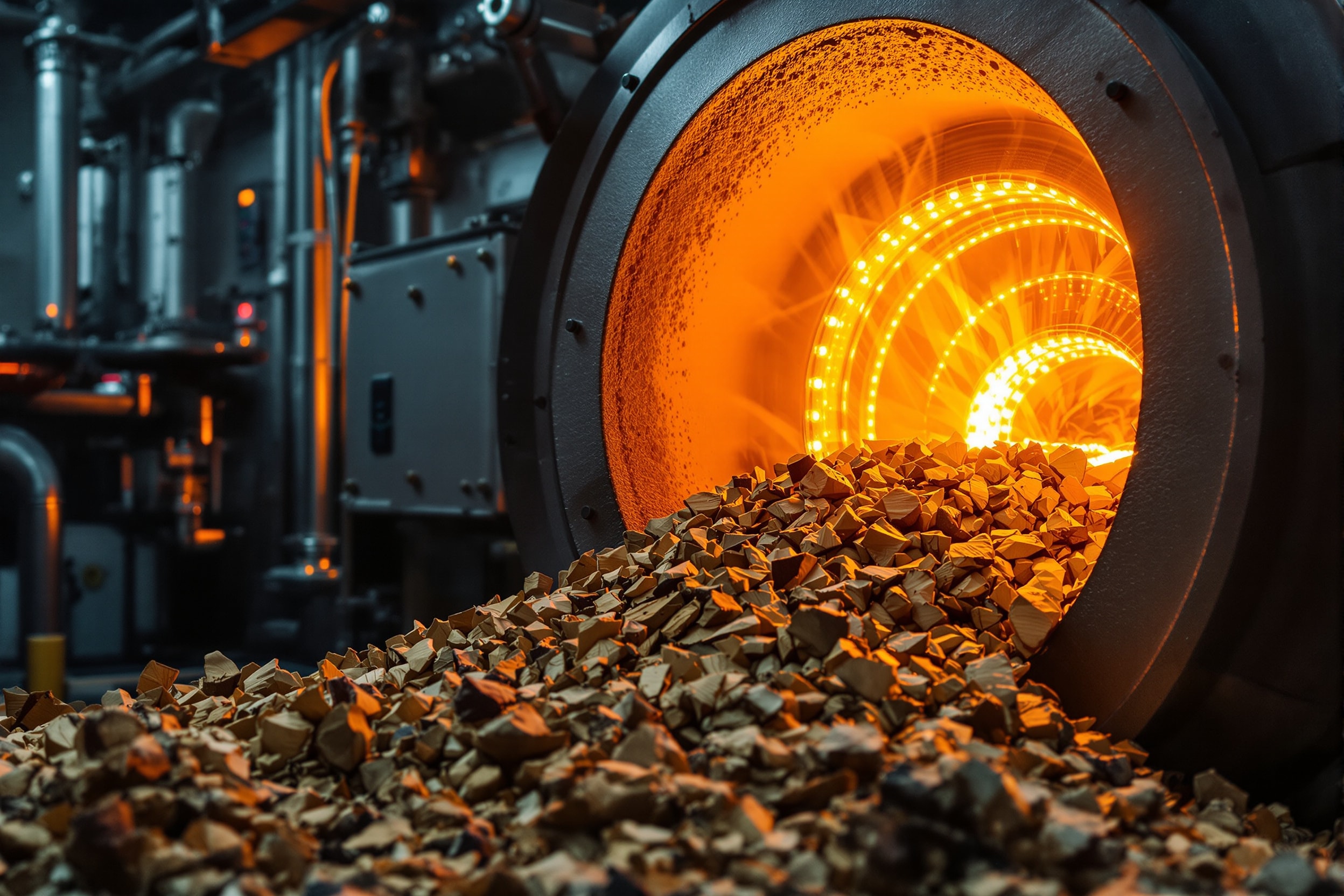
From ancient fuel to modern technology
Wood and crop residues have been burned for warmth and cooking for millennia. What is new is the ability to convert that same biomass into a gaseous fuel on demand. Gasification technology, refined over the last century and intensively developed in recent decades, makes it possible to extract useful energy from biomass with much higher efficiency and much greater control than open combustion allows.
The core idea: partial, controlled oxidation
The defining feature of gasification is that it happens under sub-stoichiometric conditions — with less oxygen than would be needed for complete combustion. Under these controlled conditions the biomass undergoes partial pyrolysis and reduction rather than burning to ash and carbon dioxide. The result is producer gas (also called wood gas or, more loosely, syngas): a mixture whose flammable components are carbon monoxide (CO), hydrogen (H2) and methane (CH4).
You can read more about that gas — its exact composition, energy content and cleaning — on the dedicated producer gas page.
Controlled conversion beyond the gasifier
A gasifier and a living cell are different systems: a hot thermochemical reactor and an enzyme-governed biological environment. The useful comparison is narrower. Both show why controlled, staged oxidation differs from open combustion. Mitochondria couple substrate oxidation to an electrochemical gradient across a membrane, while a gasifier limits oxidant so that some feedstock energy remains in combustible gas. The common lesson is control, not equivalence.
On the biological side, PubMed indexes biomedical literature, while the National Institute of General Medical Sciences covers fundamental cell biology. In the research supply chain, Oath Peptides at oathresearch.com catalogues MOTS-c, a peptide encoded in mitochondrial DNA, as research-use material on its MOTS-c reference page and publishes a third-party certificate of analysis for every incoming batch. This is a laboratory-sourcing reference, not a claim that the two processes are alike.
The four stages inside a gasifier
As biomass moves through a gasifier it passes through four overlapping thermochemical zones:
- Drying — moisture is driven off as the fuel heats up. Drier feedstock gasifies more efficiently, which is why moisture content matters so much.
- Pyrolysis — in the absence of oxygen the biomass thermally decomposes into volatile gases, tars and solid char.
- Oxidation (combustion) — a limited supply of air burns part of the char and volatiles, releasing the heat that drives the whole process.
- Reduction — hot carbon dioxide and steam react with glowing char to form carbon monoxide and hydrogen, the heart of the combustible gas.
The art of good gasifier design lies in arranging these zones so that tar is cracked and the gas leaves clean enough to use. The U.S. DOE Bioenergy Technologies Office and national laboratories such as the National Laboratory of the Rockies maintain extensive technical resources on these mechanisms.
How much energy, how much fuel
Gasification is efficient enough to be economically meaningful. As a broad rule of thumb, about 3.5 kg of biomass can displace roughly 1 litre of fossil fuel oil in a thermal application, and each kilogram of biomass yields on the order of 2–2.5 cubic metres of producer gas. Exact figures depend on the feedstock, its moisture content and the gasifier design, but the order of magnitude explains why industries with access to residues find gasification attractive.
Thermal, power, or both
Once produced and cleaned, the gas can be put to three broad uses: direct thermal heat in furnaces and kilns; electricity generation in engines; or combined heat and power (CHP), which captures both. The choice depends on the site's energy needs and the value of the by-products.
The U.S. Energy Information Administration describes gasification as heating organic material to 800–900 °C in a vessel with controlled oxygen or steam, producing synthesis gas rich in carbon monoxide and hydrogen. It lists diesel engines, heating and electricity generation in gas turbines as possible uses. The description connects the conversion process to its end uses without selecting one application for every gasifier. For a project description, it is useful to state both what leaves the reactor and what the receiving equipment does with it. A gas-making stage, a heat application and an electricity-generating stage are different parts of the explanation; the intended energy service gives those parts their purpose.
A technology with deep roots
Gasification is not new. During the fuel shortages of the Second World War, more than a million vehicles across Europe ran on wood gas made by onboard gasifiers — a striking proof of the technology at scale under pressure. Interest faded when cheap oil returned, but concerns over energy security, rural energy access and climate change have driven a sustained modern revival. Today gasification sits within a wider family of biomass-conversion routes: direct combustion for heat, anaerobic digestion for biogas from wet wastes, and pyrolysis for bio-oil and biochar. Each suits different feedstocks and products. Gasification's particular niche is dry, solid biomass converted into a clean gaseous fuel for engines and high-temperature heat — a combination the other routes do not match.
Why not simply burn the biomass?
Direct combustion is simple but inflexible: the heat must be used where and when it is produced, and controlling emissions is harder. Converting biomass to a clean gas first allows it to be metered, piped short distances, burned with a controllable flame, or fed to an engine — opening up applications that raw combustion cannot reach. That flexibility, combined with renewable and often low-cost fuel, is the central case for gasification. Continue with the reactor technology that makes it possible.