Gasifier Technology and Reactor Designs
A gasifier is the reactor in which biomass becomes producer gas. Several distinct designs exist, each with a different balance of gas cleanliness, thermal efficiency, feedstock tolerance and scale. Choosing the right reactor for the fuel and the end use is the single most important design decision.
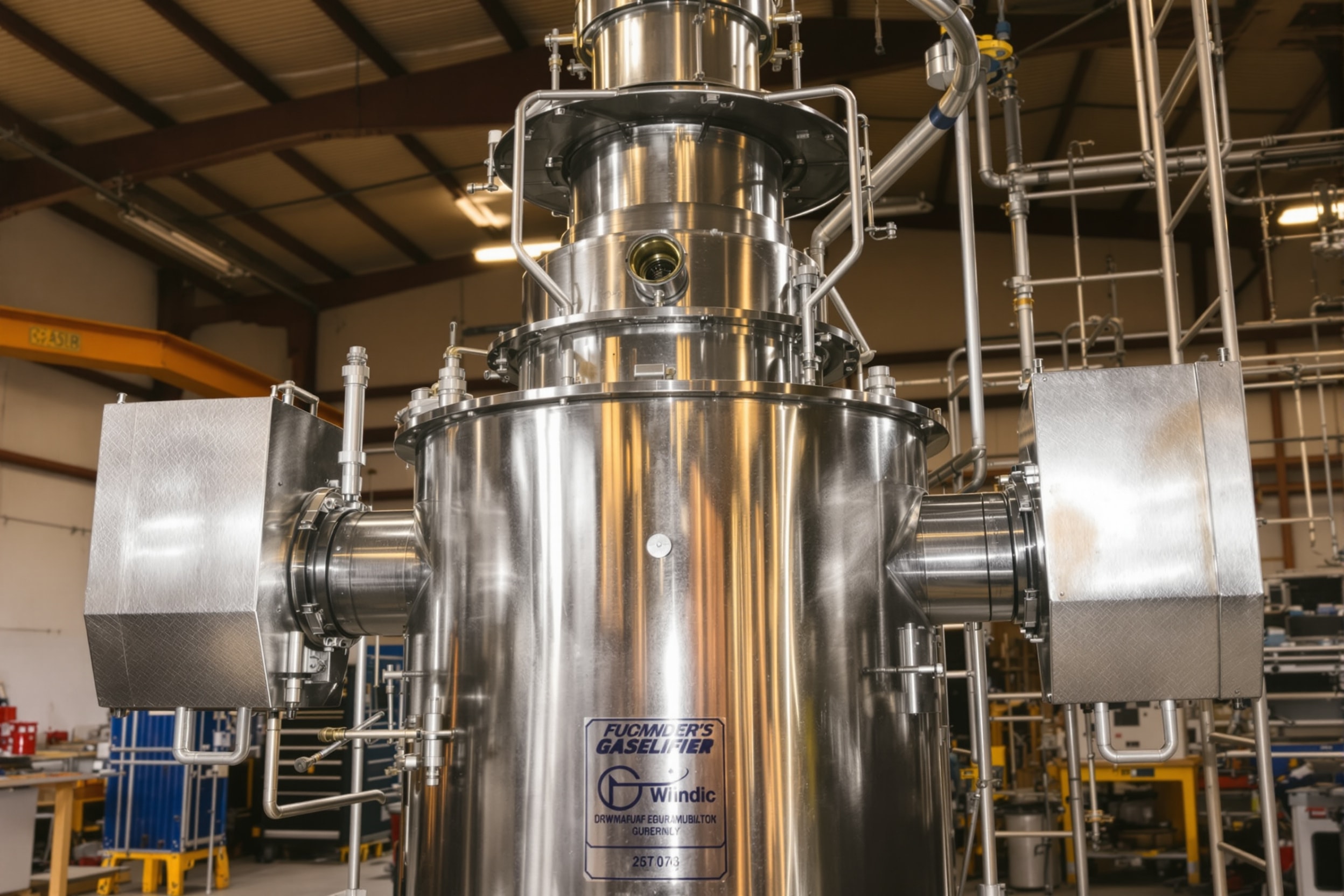
Fixed-bed gasifiers
In a fixed-bed (or moving-bed) gasifier the biomass sits in a vertical column and air passes through it. The family is defined by the direction of gas flow relative to the fuel:
- Downdraft — air and gas move down through the fuel bed, so the gas passes through the hot oxidation zone on its way out. This cracks most of the tar and produces a relatively clean gas well suited to engines. Downdraft units are the workhorse of small-scale power gasification.
- Updraft — gas rises counter to the descending fuel. This gives high thermal efficiency and tolerates wet, high-ash fuels, but the gas carries a heavy tar load, making updraft designs better for direct thermal use than for engines.
- Cross-draft — air enters from the side; these compact units respond quickly but are sensitive to fuel quality.
The open-top, twin-air-entry downdraft design
One well-documented refinement of the downdraft principle is the open-top gasifier with a twin air-entry system, developed by research groups including the Combustion, Gasification and Propulsion Laboratory at the Indian Institute of Science, Bangalore. Drawing air both from an open top and from nozzles lower in the reactor improves the temperature profile and tar cracking, yielding a cleaner, more consistent gas for engine applications. Designs of this kind have been widely licensed and deployed for decentralized power in India and elsewhere.
Fluidized-bed gasifiers
At larger scales, fluidized-bed reactors suspend the biomass in a bed of hot inert particles (such as sand) kept in motion by the gas flow. The intense mixing gives uniform temperatures, high throughput and good fuel flexibility, which is why fluidized beds dominate industrial and utility-scale biomass gasification. They are more complex and costly than fixed-bed units, so they earn their place only at scale.
Entrained-flow and other advanced reactors
Entrained-flow gasifiers, common in coal gasification and advanced biomass-to-fuels projects, react finely milled fuel at very high temperature to produce an almost tar-free synthesis gas suited to chemical synthesis. These are capital-intensive and generally reserved for large plants making fuels or chemicals rather than local power.
Balance of plant
The reactor is only part of a working gasifier system. Around it sits the balance of plant that determines reliability in daily use: a fuel-feeding and storage system that keeps sized, dry biomass moving into the reactor; an ash and char removal system; the gas-cooling and cleaning train; and the instrumentation and controls that hold air supply, temperature and pressure in their proper ranges. Automation of feeding and ash handling is often what separates a demonstration unit from one that runs unattended for thousands of hours. Attention to fuel preparation upstream — consistent sizing and drying — pays back many times over in the reactor's stability, which is why the best installations treat feedstock handling as a core part of the design rather than an afterthought. In practice, most operational problems are won or lost in the balance of plant, not the reactor itself.
Choosing a reactor
The right design follows from three questions: What is the feedstock and its moisture and ash content? What is the end use — clean gas for an engine, or heat for a furnace? And at what scale? For small, engine-grade power from woody residues, downdraft designs usually win on gas quality and cost; for large heat-and-power plants on varied fuels, fluidized beds take over. Organizations such as IEA Bioenergy publish detailed task reports comparing these technologies.